
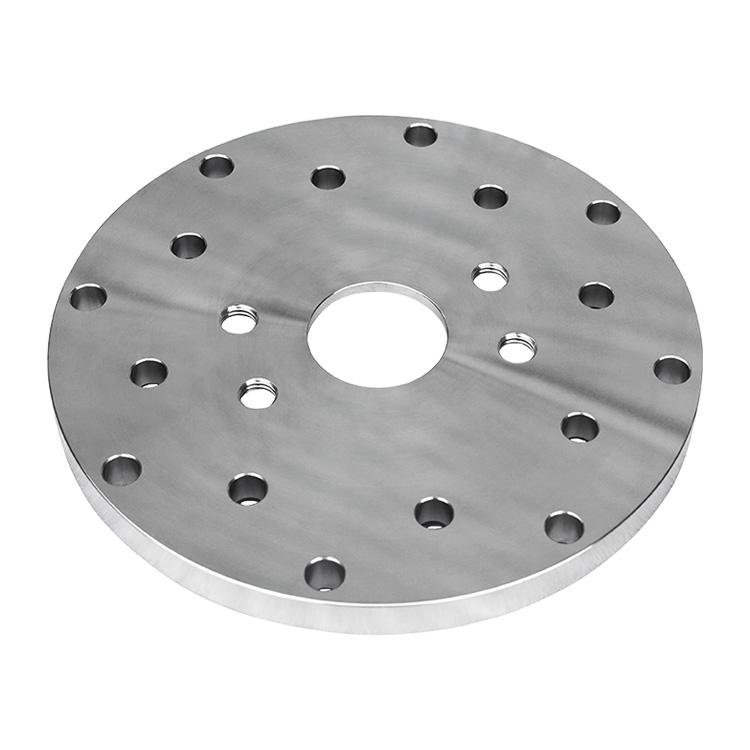
Carbon steel Non-standard Flange for industrial equipment is a highly practical and widely used
mechanical connection component in modern industrial piping, machinery, pressure systems, and process equipment.
Unlike standard flanges defined by fixed dimensions and common international norms, a non-standard flange is
manufactured according to special drawings, customized dimensions, unique drilling patterns, or application-specific
installation requirements. When carbon steel is used as the base material, the flange offers strong mechanical
performance, reliable pressure resistance, cost efficiency, and excellent suitability for demanding industrial
environments.
In industries where equipment design varies from one project to another, standard flange sizes are not always enough.
Many industrial systems require special bolt circle diameters, unusual hub lengths, custom thickness, modified
sealing faces, extra corrosion allowance, or special connection geometry. This is where a carbon steel
non-standard flange becomes an essential solution. It supports flexible engineering design, helps solve
installation challenges, and ensures a secure and durable joint between pipes, vessels, pumps, valves, reactors,
heat exchangers, and other industrial equipment.
This page provides an SEO-friendly overview of carbon steel non-standard flange products, including definitions,
main advantages, common applications, manufacturing considerations, material characteristics, specification tables,
and technical selection factors. The information below is suitable for industrial catalog pages, blog posts, product
category pages, and other search-engine-oriented content formats.
A carbon steel non-standard flange is a flange that does not follow a fixed standard size or
standard pattern such as ANSI, ASME, DIN, JIS, BS, or EN dimensions. Instead, it is designed and manufactured based
on custom project requirements. These flanges are typically used when the connection interface of industrial
equipment differs from common pipeline norms or when the project requires a special structural or sealing design.
Carbon steel is one of the most common materials used for non-standard flanges because it provides a strong balance
of strength, machinability, weldability, and affordability. Depending on the service environment, the flange may be
made from low carbon steel, medium carbon steel, or specific forged carbon steel grades. The final product may be
fabricated as a Weld Neck Flange, blind flange, slip-on flange, threaded flange, lap joint flange, or a fully custom
connection interface.
The term non-standard flange usually refers to one or more of the following:
In industrial equipment systems, this customization is important because a perfect fit improves sealing performance,
reduces leakage risk, simplifies installation, and enhances overall system reliability.
Carbon steel is a preferred base material for many types of Industrial Flanges because it combines structural
strength with practical manufacturing advantages. For non-standard flange production, this is especially valuable,
since custom dimensions may require precision machining, forging, welding, or drilling adjustments. Carbon steel can
be shaped, cut, forged, and machined efficiently, making it a suitable choice for tailored industrial components.
| Material Feature | Carbon Steel Advantage for Non-standard Flanges |
|---|---|
| Strength | Provides solid mechanical support for pressure-bearing and structural connections |
| Machinability | Easy to machine into custom sizes, faces, and bolt hole arrangements |
| Weldability | Suitable for welding to pipes, vessels, and equipment necks |
| Cost Efficiency | Generally more economical than many alloy alternatives |
| Availability | Commonly available in multiple grades and forms |
| Adaptability | Can be manufactured to custom drawings and special project requirements |
Carbon steel flanges are especially popular in general industry, power generation, water treatment, oil and gas
auxiliary systems, chemical processing support systems, mining equipment, shipbuilding, and heavy machinery
applications. When a standard flange cannot satisfy the installation geometry, carbon steel offers an adaptable and
durable solution.
Choosing a carbon steel non-standard flange for industrial equipment offers several important
advantages. These benefits support not only mechanical performance but also design flexibility, maintenance
efficiency, and overall project compatibility.
One of the greatest advantages is the ability to match the exact dimensions of industrial equipment. Many machines
and systems are built with special connection points, so a Custom Flange ensures accurate alignment and proper
assembly. This reduces installation issues and avoids costly modifications on-site.
Carbon steel provides strong load-bearing capability and dependable structural integrity. In industrial equipment
that experiences vibration, pressure variation, thermal cycles, or operational stress, a carbon steel non-standard
flange can maintain connection stability and support long-term service.
Compared with stainless steel or exotic alloys, carbon steel is often more affordable while still delivering
excellent performance in many industrial environments. For projects requiring large quantities or custom fabrication,
this cost advantage can be significant.
Non-standard flanges can be produced through forging, casting, cutting, machining, or welded fabrication depending on
the required strength, shape, and application. This manufacturing flexibility helps engineers match the flange to
the function of the equipment rather than forcing the equipment to match a standard part.
Many industrial plants need replacement flanges for older equipment or imported machinery that does not follow local
standard sizes. Non-standard carbon steel flanges are ideal for retrofitting, maintenance upgrades, and part
replacement when original dimensions are unusual or no longer available as standard stock.
When properly designed and machined, a carbon steel non-standard flange can provide excellent sealing performance.
This is important in systems carrying water, steam, oil, gas, chemicals, slurry, or process fluids. Correct face
finish and bolt load distribution contribute to reliable sealing and reduced leak risk.
The use of carbon steel non-standard flanges spans many industries and equipment types. Whenever a
project involves a special connection interface, unique pressure connection, or custom mounting requirement, a
non-standard flange may be the best technical solution.
| Industrial Sector | Typical Application |
|---|---|
| Oil and Gas | Process piping, separators, skids, pressure vessels, auxiliary systems |
| Chemical Processing | Reactor connections, tank nozzles, transfer lines, custom sealing interfaces |
| Power Generation | Steam systems, cooling systems, boiler auxiliaries, equipment tie-ins |
| Water Treatment | Pumps, filters, treatment skids, pipeline transitions, custom equipment joints |
| Mining and Minerals | Slurry lines, heavy-duty pumps, process vessels, wear-prone systems |
| Shipbuilding | Marine piping, onboard equipment, engine room systems, retrofit assemblies |
| Food and Beverage | Process equipment, transfer connections, utility systems, custom machinery interfaces |
| General Machinery | Machine frames, hydraulic systems, customized installation points, equipment adaptation |
In these applications, the flange is not only a pipe connector. It is also part of the broader equipment design,
influencing alignment, structural support, maintenance access, and operational safety. That is why custom flange
development is often a critical part of industrial equipment engineering.
Although the term non-standard suggests custom design, many carbon steel non-standard flanges are based on common
flange styles. The difference is that their dimensions, drilling, or face configuration are adapted to specific
requirements. Below are common types used in industrial equipment.
| Flange Type | Description | Typical Use |
|---|---|---|
| Weld Neck Non-standard Flange | Has a long tapered hub for strong welded connection | High-pressure equipment, critical piping, pressure vessels |
| Slip-on Non-standard Flange | Slides over the pipe and is welded in place | General industrial equipment and moderate-duty systems |
| Blind Non-standard Flange | Used to close the end of a pipe, nozzle, or opening | Isolation, pressure testing, maintenance closure |
| Threaded Non-standard Flange | Uses internal threads instead of welding | Low-weld applications, maintenance-friendly connections |
| Lap Joint Non-standard Flange | Used with a stub end for easy alignment and disassembly | Frequent maintenance, rotating assemblies, special process systems |
| Custom Equipment Flange | Made directly from equipment drawings with special geometry | Unique machinery, retrofit projects, non-standard interfaces |
Some custom flanges may also feature special grooves, raised faces, flat faces, tongue-and-groove faces, ring-type
joints, or machined sealing profiles. The design choice depends on pressure class, gasket type, temperature, media,
and equipment requirements.
Different carbon steel grades can be used according to strength, machinability, temperature range, and service
environment. The following table shows commonly referenced materials for industrial flange fabrication. Actual grade
selection should always be based on the project specification and applicable engineering standard.
| Carbon Steel Grade | Main Characteristics | Typical Use |
|---|---|---|
| ASTM A105 | Forged carbon steel, widely used for pressure parts | Piping flanges, valves, fittings, general industrial equipment |
| ASTM A350 LF2 | Low-temperature carbon steel with improved toughness | Cold-service flanges and low-temperature applications |
| ASTM A181 | Forged carbon steel for moderate service conditions | General-purpose flanges and structural connections |
| ASTM A516-related material | Often used where plate-based fabrication is required | Special fabricated flanges and custom equipment parts |
| EN S235 / S275 / S355 | Structural carbon steel grades used in some custom fabrication work | Non-pressure structural flange components and equipment interfaces |
It is important to understand that the exact material specification may vary by region, industry, pressure code, and
customer requirement. For high-pressure or critical applications, forged carbon steel grades are often preferred due
to their superior consistency and strength.
A flange becomes non-standard when one or more dimensions differ from a recognized standard series. In industrial
equipment, even a small variation in diameter, thickness, bolt circle, or hole pattern can make a flange unique. The
most common non-standard factors include the following.
In many cases, a non-standard flange is not simply “custom” in appearance. It is functionally engineered to solve a
compatibility issue between the connecting components. This makes it highly valuable in industrial equipment design,
especially for legacy systems, imported machinery, or low-volume special-purpose production lines.
The following table provides a general technical reference for carbon steel non-standard flange products. Actual
values depend on project drawings, pressure rating, material grade, and final machining requirements.
| Parameter | Typical Range / Option |
|---|---|
| Product Name | Carbon Steel Non-standard Flange |
| Material | Carbon steel, forged carbon steel, plate carbon steel, or custom grade |
| Flange Type | Weld neck, slip-on, blind, threaded, lap joint, custom |
| Size Range | Custom-made according to drawing or sample |
| Pressure Rating | Custom or standard-related pressure classes |
| Face Type | RF, FF, RTJ, custom machined sealing face |
| Manufacturing Method | Forging, machining, cutting, drilling, welding, fabrication |
| Surface Finish | Machined, anti-rust coated, painted, oiled, or custom finish |
| Connection | Welded, bolted, threaded, or custom integrated interface |
| Application | Industrial equipment, piping, vessels, pumps, skids, machinery |
The manufacturing process for a carbon steel non-standard flange for industrial equipment usually
starts with technical drawings, samples, or measurement data. Because the product is not a fixed standard item,
engineering accuracy is essential at every stage. The final flange must match the required connection geometry while
maintaining strength, sealing quality, and installation convenience.
In special projects, additional inspection may include ultrasonic testing, magnetic particle testing, hydrostatic
testing, or dimensional verification by coordinate measuring equipment. The required test method depends on the
application criticality and buyer specification.
To choose the right carbon steel non-standard flange, several engineering factors should be reviewed carefully.
Proper selection improves service life, reduces leakage risk, and ensures the component performs well in real
operating conditions.
| Selection Factor | Why It Matters |
|---|---|
| Pressure and Temperature | Determines required strength, thickness, and material grade |
| Media Type | Influences corrosion resistance, sealing design, and face selection |
| Pipe or Nozzle Dimensions | Ensures accurate fit and proper alignment |
| Bolt Pattern | Affects installation compatibility and sealing force distribution |
| Gasket Type | Determines face finish and surface flatness requirements |
| Installation Environment | May require coating, special protection, or maintenance access design |
| Equipment Movement or Vibration | May require stronger flange construction or enhanced connection design |
For industrial equipment, compatibility is just as important as strength. A flange that is technically strong but
dimensionally mismatched can create installation delays and sealing problems. Therefore, precise measurement and
drawing confirmation are essential before manufacturing begins.
Carbon steel is durable and strong, but it is also susceptible to corrosion if left unprotected in humid or chemical
environments. For this reason, many carbon steel non-standard flanges receive a protective surface treatment.
Protection methods help preserve appearance, reduce rust, and improve storage and transportation performance.
| Surface Treatment | Purpose |
|---|---|
| Oil Coating | Provides temporary rust prevention during storage and shipping |
| Black Paint | Offers general surface protection for industrial use |
| Galvanizing | Improves corrosion resistance in certain environments |
| Epoxy Coating | Provides stronger protection for moisture-prone service areas |
| Phosphating | Improves surface preparation and corrosion resistance |
| Machined Bare Surface | Used where the flange face or sealing area must remain uncoated |
Surface treatment should always be selected according to the operating environment. For high-temperature systems,
special coatings may not be suitable on sealing surfaces, while for outdoor equipment, a stronger anti-corrosion
finish is often recommended.
Quality control is essential because non-standard products must meet drawing-specific requirements with high
precision. A reliable carbon steel non-standard flange should undergo thorough inspection before delivery to ensure
dimensional accuracy, surface integrity, and manufacturing consistency.
In industrial equipment systems, flange failure can lead to leakage, shutdown, or maintenance disruption. That is
why custom flange quality control is not optional. It is a key part of safe and reliable industrial operation.
From a broader project perspective, using the correct carbon steel non-standard flange can improve overall industrial
efficiency. A well-designed custom flange reduces the need for on-site rework, shortens installation time, and
improves compatibility across multiple system components. This is especially valuable in large industrial projects
where equipment coordination is complex.
Efficiency also comes from easier maintenance planning. Custom flanges can be designed with access, disassembly, and
replacement in mind. In systems that need periodic inspection or cleaning, the right flange design can reduce
downtime and support quicker service work. This is one reason non-standard flanges are widely used in process plants,
utility systems, and heavy machinery environments.
For SEO purposes, this topic is commonly associated with the following search terms:
Naturally integrating these keywords into product descriptions, category pages, technical guides, and specification
content can improve search visibility while helping readers understand the product more clearly.
The following comparison highlights the difference between standard flange products and custom non-standard
solutions used in industrial equipment.
| Aspect | Standard Flange | Carbon Steel Non-standard Flange |
|---|---|---|
| Dimensions | Fixed by standard tables | Customized to project drawings |
| Bolt Pattern | Standardized | Custom drilling or bolt circle |
| Application | Common piping and general systems | Special industrial equipment and unique interfaces |
| Availability | Often available from stock | Usually made to order |
| Flexibility | Limited to standard sizes | High flexibility in shape and size |
| Installation Compatibility | Suitable for standard systems | Ideal for unusual or legacy equipment |
| Cost | Usually lower for common sizes | May vary depending on complexity |
A carbon steel non-standard flange for industrial equipment is a practical, durable, and highly
adaptable connection solution for modern industry. It supports custom design requirements where standard flange
dimensions cannot meet the needs of a specific machine, process line, or pressure system. With its excellent
combination of strength, machinability, weldability, and cost efficiency, carbon steel remains one of the most
important materials for custom flange production.
Whether used in oil and gas auxiliaries, chemical processing equipment, power systems, water treatment units,
machinery retrofits, or heavy industrial installations, a non-standard flange helps ensure accurate fit, strong
sealing, and long-term operational reliability. When properly engineered and manufactured, it becomes an essential
part of the connection strategy for industrial equipment.
For SEO-focused industrial content, this topic offers strong keyword relevance, clear technical structure, and broad
commercial search intent. By using precise headings, specification tables, comparison tables, and industry-focused
terminology, a page about carbon steel non-standard flange can be optimized for both user value and search engine
visibility.
```


Copyright © 2022 Zhejiang Songlin Flange Co., Ltd.
SitemapThis website uses cookies to ensure you get the best experience on our website.

 Español
 Pусский
 Français
 Deutsch
 日本語
日本語 한국어
한국어 العربية
 Italiano
 Nederlands



 WhatsApp
 Phone
Phone
Comment
(0)